
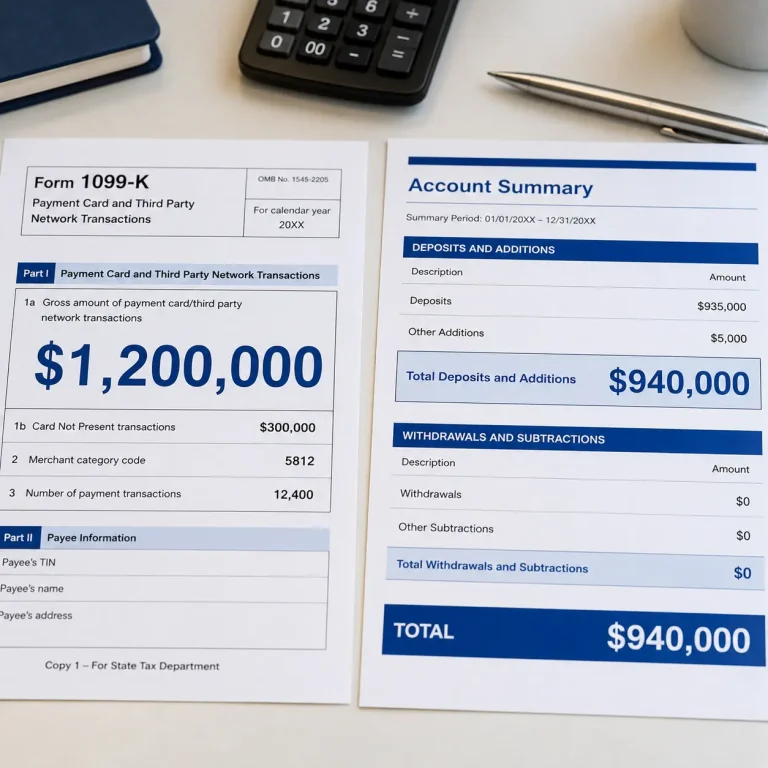
Sales Are Growing. But Your Bank Balance Says Otherwise. Here’s What’s Really Behind The 1099-K Gap.
It’s Mid-January. You Open Your 1099-K. Total Reported Sales: $1.2M. You Check Your Bank Deposits For The Year.
Total Deposits Show $940,000. That’s A $260,000 Gap.And The First Thought Is Always The Same:
“Where Did The Money Go?”
Then The Second Thought Hits Harder:
“Is The IRS Going To Tax Me On The Full $1.2M?”
This Is Not A Rare Situation.
In Fact, Most Ecommerce Businesses Run Into This Problem, Especially Those Selling Through Platforms Like Shopify, Amazon, Stripe, Paypal, Or Marketplaces.
The Issue Is Not Missing Money. It Is Misaligned Financial Understanding.
We See This Consistently With Ecommerce Businesses, Especially Those Operating Across Multiple Platforms.
What The 1099-K Actually Shows (And Why It Confuses Business Owners)
The 1099-K Is Straightforward In What It Reports. But Business Owners Often Misunderstand What It Actually Means. At Its Core, The 1099-K Shows:
The Total Gross Amount Of Payments Processed Through A Platform.
Not:
- What You Actually Received In Your Bank
- What You Earned After Fees
- What You Keep As Profit
Just Gross Transaction Volume.
And This Is Where Confusion Begins. Because That Number Reflects Gross Reportable Payment Volume, Not The Amount That Ultimately Lands In Your Bank Or The Amount You Should Treat As Revenue For Tax And Reporting Purposes.
It Does Not Reflect The Full Economic Reality Of The Business After Items Like:
- Processing Fees
- Refunds And Credits
- Discounts And Adjustments
- Timing Differences Between Sale Date And Payout Date
- Sales Tax Collected But Not Retained As Revenue
What This Looks Like In Practice
A Customer Pays:
- Product: $100
- Shipping: $10
- Sales Tax: $8
Total Transaction: $118 → Reported In 1099-K.
But The Cash That Lands In Your Bank Is Reduced By:
- Ongoing Platform Subscriptions (Shopify, Apps, Saas Tools)
- Advertising Spends (Meta, Google, Tiktok)
- Refunds Issued After The Sale
- Timing Differences Between Sale And Payout
- Storage And Fulfillment Fees
- Marketplace Commissions
- Server And Infrastructure Costs
- Protection, Compliance, And Platform Add-Ons
👉 So You’re Comparing:
A Gross Platform Number ($118) Vs A Net Cash Outcome (~$95–$105 Depending On Factors).
Why This Becomes A Real Business Problem
Most Business Owners Don’t Realize This Difference Early.
So They:
- Compare 1099-K To Bank Deposits
- Assume Something Is Missing
- Or Worse—Assume The 1099-K Reflects True Revenue
And That Leads To:
- Confusion During Tax Filing
- Incorrect Financial Assumptions
- Mismatched Expectations Between Sales And Cash
The Issue Isn’t The Form. It Is Using A Gross Reporting Number To Understand A Net Financial Reality.
Where The Gap Actually Comes From (In Real Operations)
Let’s Walk Through How This Actually Plays Out Inside A Real Ecommerce Business. Because This Gap Doesn’t Come From One Issue.
It Builds Quietly—Layer By Layer—Until The Numbers Stop Making Sense.
Scenario
You Run An Ecommerce Store Across Shopify And Stripe.
At The End Of The Year, Your 1099-K Shows $1,200,000 In Total Sales.
But When You Check Your Bank, Total Deposits Are Around $940,000
That’s A $260,000 Gap. Nothing Seems “Wrong” Individually. But Together, It Doesn’t Add Up.
1. It Starts With Fees—But You Don’t Really Notice Them
Every Sale Comes With A Small Deduction. 2.9%, 3.2%, Sometimes More Depending On The Platform.
Individually, It Feels Insignificant. But Over Time, It Adds Up In A Way Most Business Owners Don’t Track Closely.
What It Looks Like In Practice:
Out Of Your $1,200,000 In Sales, Roughly $35,000–$40,000 Goes To Processing Fees.
But You Never “Pay” This Separately. It’s Simply Deducted Before Funds Ever Reach Your Account.
👉 So Your Real Starting Point Isn’t $1.2M Anymore. It’s Already Closer To ~$1,160,000.
2. Then Come Refunds—Which Reverse Cash, Not Just Sales
Refunds Don’t Feel Like Part Of “Sales.” They Feel Like Exceptions. But Operationally, They Have A Direct Impact On Your Cash.
What Actually Happens:
Let’s Say Over The Year, You Process $150,000 In Refunds.
That Money:
- Was Once Counted As Revenue
- Then Left Your Bank
👉 Now Your Position Shifts Again:
- From ~$1,160,000
- Down To Around $1,010,000
And Here’s The Subtle Issue:
You Remember The Sales. But You Don’t Always Track The Full Impact Of The Reversals.
3. Sales Tax Inflates The Top Line—But Isn’t Yours
This Is One Of The Biggest Hidden Distortions.
- Customers Pay It.
- Platforms Report It.
- But You Never Own It.
What It Looks Like:
Let’s Say You Collected $90,000 In Sales Tax.
That Amount:
- Shows In Your 1099-K
- Flows Through Your System
But Eventually It Goes To The State.
👉 So Now ~$1,010,000 Becomes Closer To $920,000 In Actual Business Revenue.
And This Is Where Many Businesses Make Mistakes. They Treat Gross Sales As Earned Revenue.
4. Timing Differences Quietly Distort The Picture
Now Comes Something Less Obvious—But Very Real. Not All Money Arrives When The Sale Happens.
What Actually Happens:
- You Make $60,000 In Sales At The End Of December
- But The Payout Hits Your Bank In January
So:
- 1099-K Includes It
- Bank Does Not
👉 Now Your Numbers Shift Again: ~$920,000 Down To Around $860,000 (For That Year’s Deposits).
This Isn’t An Error. But If You Don’t Understand It, It Looks Like One.
5. Small Adjustments Add Up More Than You Expect
These Don’t Stand Out Individually:
- Chargebacks
- Disputes
- Platform Adjustments
- Currency Conversion Differences
What It Looks Like Over Time:
Let’s Say These Total Around $15,000–$25,000 Annually.
👉 Now Your Position Becomes Closer To $840,000–$845,000.
Now, Step Back And Look At The Full Picture
You Started With $1,200,000 (1099-K) And You End Up With ~$840,000–$940,000 In Actual Deposits.
👉 That’s Your Gap.
What This Really Means:
At No Point Was Money Actually Missing. The Difference Comes From How The Numbers Are Structured.
What Actually Happened Is This:
You Were Looking At One Number That Represents Activity And Comparing It To Another That Represents Cash Outcome.
And Without Breaking It Down Like This:
- Fees Feel Invisible
- Refunds Feel Disconnected
- Taxes Feel Like Revenue
- Timing Feels Like Error
Why This Matters For Real Businesses
Because This Gap Doesn’t Stay In Reports. It Shows Up In Decisions.
You Might:
- Assume Margins Are Stronger Than They Are
- Spend Based On Inflated Revenue
- Miscalculate Taxes
- Feel Constant Pressure On Cash Flow
And The Most Common Reaction Is: “Something Is Off With The Numbers.”
But The Reality Is: The Numbers Are Correct, But The Interpretation Is Not.
What This Leads To (Where Businesses Actually Get Hurt)
At This Point, The Issue Is No Longer About Reconciliation. It Starts Showing Up In Decisions, Cash Flow, And Pressure Across The Business.
Because Once Your Numbers Don’t Align, Everything Built On Top Of Them Starts To Weaken.
1. You End Up Paying Tax On Money You Never Actually Made
This Is One Of The Most Expensive Mistakes—And It Happens More Often Than Most Realize.
When Businesses Rely On 1099-K Totals Without Proper Adjustments, They End Up Reporting Inflated Revenue.
What This Looks Like In Practice:
- 1099-K Shows: $1,200,000
- Actual Adjusted Revenue: Closer To $980,000–$1,000,000
That’s A Difference Of $200,000+
If That Gap Isn’t Properly Accounted For:
- You Could Be Taxed On Income That Includes:
- Fees
- Refunds
- Sales Tax
👉 At A 25% Effective Tax Rate, That Could Create More Than $50,000 Of Unnecessary Tax Exposure.
And Most Businesses Don’t Realize This Until:
- Tax Filing
- Or Worse, After Filing
2. You Make Decisions Based On Inflated Performance
This Is Where The Problem Becomes Operational Because The Numbers You Trust Are Not Reflecting Reality.
What Actually Happens:
You Look At Your Reports And See:
- Strong Sales Growth
- Healthy Margins
- Consistent Performance
So Naturally, You Decide To:
- Increase Ad Spend
- Hire Additional Team Members
- Expand Inventory
But The Underlying Reality Is Different
Because After:
- Fees
- Refunds
- Timing Differences
Your Real Margin Is Lower Than It Appears.
👉 Example:
- Reported Margin: 20%
- Actual Margin: Closer To 12–14%
That Difference Doesn’t Look Big On Paper. But Operationally, It Means:
- You’re Scaling On Thinner Margins Than Expected
- Cash Gets Tight Faster Than Planned
And The Most Common Reaction Becomes: “Sales Are Growing—But Something Feels Off.”
3. Cash Flow Starts Feeling Unpredictable
This Is Usually The First “Felt” Problem. Not In Reports—But In Day-To-Day Operations.
What Actually Happens:
You See Strong Revenue Numbers. But:
- You Delay Vendor Payments
- You Hesitate On Purchases
- You Constantly Check Your Bank Balance
Because: Sales Don’t Match Cash.
Real-World Pattern: You Expect ~$100K Monthly Inflow, But Only See ~$75K–$85K In Actual Deposits
The Gap Comes From Fees, Refunds, Tax, And Timing.
But Without Clarity, It Feels Like: “Cash Is Disappearing.” And That Uncertainty Affects Planning, Confidence, And Decision Speed.
4. Year-End Becomes Reactive And Stressful
This Issue Usually Peaks When:
- Books Need To Be Finalized
- Taxes Need To Be Filed
- Numbers Need To Be Explained
What Actually Happens:
- Accountant Asks For Reconciliation
- 1099-K Doesn’t Match Books
- Adjustments Are Unclear Or Incomplete
Now The Business Is Forced Into Backtracking Transactions, Rebuilding Numbers, And Explaining Gaps Under Time Pressure.
In Real Terms:
What Could Have Been A Structured Monthly Process Becomes A Rushed, Reactive Cleanup.
And This Is Where Mistakes Happen:
- Missed Adjustments
- Incorrect Filings
- Inconsistent Reporting
5. You Start Losing Confidence In Your Own Numbers
This Is The Most Overlooked—But The Most Important Impact. Because Once Trust In Numbers Is Gone: Everything Slows Down.
What Actually Happens:
- You Double-Check Reports Before Making Decisions
- You Rely More On “Gut Feeling” Than Financials
- You Delay Decisions Because Numbers Don’t Feel Reliable
And Over Time, The Financial System Stops Being A Tool—And Becomes A Source Of Friction.
This Shows Up As:
- Slower Decision-Making
- Missed Opportunities
- Increased Stress Around Growth
What Smart Ecommerce Businesses Do Differently
At Some Point, Experienced Ecommerce Operators Stop Trying To “Match Numbers.” They Shift Their Focus To Something More Important:
Understanding How Their Numbers Actually Work.
Because Once You Understand The Structure Behind The Gap, You Stop Reacting—And Start Controlling It.
1. They Stop Treating Bank Deposits As Revenue
This Is Usually The First Shift. Less Experienced Businesses Think:
“Money In The Bank = Revenue”
But That Assumption Breaks Quickly At Scale.
What Smart Businesses Do Instead:
They Separate:
- Gross Sales (Platform Level)
- Net Revenue (After Adjustments)
- Cash Received (Bank Deposits)
In Practice:
Using The Earlier Example:
- 1099-K Shows: $1,200,000
- True Revenue After Adjustments: ~$980,000
- Actual Cash Movement: ~$840,000–$940,000
👉 These Are Treated As Three Different Numbers—Not One
Because Each Answers A Different Question:
- How Much Did We Sell?
- How Much Did We Actually Earn?
- How Much Cash Do We Have?
2. They Reconcile At The Platform Level—Not Just The Bank
Most Businesses Try To Reconcile:
Bank Deposits ↔ Accounting Records
That’s Where Things Break.
What Smart Businesses Treat Them Differently:
They Reconcile Directly Against:
- Shopify Reports
- Stripe Payouts
- Amazon Settlements
What This Allows Them To See:
- Exact Fees Deducted
- Refund Timing
- Tax Collected
- Payout Breakdown
Instead Of Guessing: “Why Doesn’t This Match?” They Can Clearly See: “This Is Where Every Dollar Went.”
If Your Numbers Don’t Reconcile At This Level, The Issue Is Not Your Sales—It’s Your Financial Structure.
3. They Treat Fees, Refunds, And Tax As Core Data—Not Adjustments
Less Structured Businesses Treat These As:
- Cleanup Items
- Year-End Adjustments
Smart Businesses Treat Them Differently
They Track, Monitor, And Review:
- Processing Fees
- Refund Rates
- Sales Tax Collected
- Chargebacks
Because These Are Not Minor Details:
In Your Example:
- Fees: ~$36,000
- Refunds: ~$150,000
- Tax: ~$90,000
👉 That’s Over $275,000 Of Movement. Ignoring This Isn’t A Reporting Issue. It’s A Visibility Problem.
4. They Understand Timing—And Plan Around It
Cash Doesn’t Move Instantly In Ecommerce. And Experienced Operators Don’t Expect It To.
What They Account For:
- Platform Payout Delays (2–7 Days Or More)
- End-Of-Month Cutoffs
- Year-End Timing Differences
In Practice:
They Know:
- December Sales May Land In January
- Weekly Payouts May Shift Reporting Periods
👉 So They Don’t Panic When:
“Sales And Deposits Don’t Match This Month”
They Already Expect It.
5. They Don’t Wait Until Year-End To Fix It
This Is One Of The Biggest Differences. Most Businesses Deal With This Gap:
- Once A Year
- Under Pressure
- With Incomplete Data
Smart Businesses Handle It Continuously. They Reconcile:
- Monthly
- Sometimes Weekly
Why Does This Matter? Because If You Wait:
- Data Becomes Harder To Trace
- Adjustments Become Guesswork
- Errors Compound Over Time
👉 What Could Have Been A 2-Hour Monthly Process Turns Into A 2-Week Year-End Cleanup
6. They Build A System—Not A Person-Dependent Process
Less Structured Businesses Rely On:
- A Person
- A Tool
- A Report
Smart Businesses Rely On Systems.
They Build:
- Clear Reconciliation Processes
- Defined Reporting Structures
- Consistent Review Cycles
So Even If Volume Grows, Platforms Increase, And Team Changes, The System Still Holds.
What This Really Changes
Once This Structure Is In Place:
- The 1099-K Stops Being Confusing
- The Gap Stops Being Concerning
- The Numbers Start Making Sense
And Most Importantly, You Stop Asking: “Where Did The Money Go?” And Start Saying: “I Know Exactly Where It Went.”
What To Do If You’re Seeing This Gap Right Now
If Your 1099-K And Bank Deposits Don’t Match, The First Instinct Is Usually:
- “Something Is Wrong”
- “We’re Missing Money”
- “The Reports Don’t Make Sense”
In Most Cases, None Of Those Are True. What’s Actually Happening Is:
You’re Trying To Reconcile Two Numbers That Were Never Meant To Match Directly.
Step 1: Stop Comparing 1099-K Directly To Your Bank
This Is Where Most Businesses Go Wrong.
They Try To Match 1099-K Total → Bank Deposits. That Will Almost Never Work Because:
- 1099-K = Gross Activity
- Bank = Net Cash After Multiple Deductions And Timing Differences
👉 Instead, Shift The Question From:
“Why Don’t These Match?”
To:
“What Sits Between These Two Numbers?”
Step 2: Break The Gap Into Components
Using The Earlier Example:
- 1099-K: $1,200,000
- Bank: ~$940,000
Gap: $260,000
Now Break That Gap Down:
- Processing Fees → ~$35K–$40K
- Refunds → ~$120K–$150K
- Sales Tax → ~$80K–$90K
- Timing Differences → ~$50K–$60K
- Other Adjustments → ~$15K–$25K
👉 When You Separate It Like This:
The Gap Stops Being Confusing. It Becomes Explainable.
Step 3: Rebuild Your Numbers From Platform Data (Not Just Bank Data)
This Is Where Clarity Starts. Instead Of Relying Only On:
- Bank Statements
- Basic Accounting Reports
Start From:
- Shopify Sales Reports
- Stripe Payout Summaries
- Amazon Settlement Reports
Then Layer In:
- Fees
- Refunds
- Taxes
- Payout Timing
👉 This Gives You A Complete Financial Picture, Not Just Cash Movement.
Step 4: Align Revenue, Cash, And Reporting—Separately
One Of The Biggest Mistakes Is Treating Everything As One Number. You Need Three Distinct Views:
1. Sales (Activity)
→ What The Platform Processed
→ Example: $1,200,000
2. Revenue (After Adjustments)
→ What You Actually Earned
→ Example: ~$980,000
3. Cash (Bank Reality)
→ What You Actually Received
→ Example: ~$840K–$940K
👉 Once These Are Separated:
- Confusion Drops
- Decisions Become Clearer
Step 5: Don’t Wait Until Year-End—Fix It Now
Most Businesses Leave This Until Tax Season, Or When Something Breaks.
That’s When It Becomes:
- Time-Consuming
- Stressful
- Harder To Fix
👉 Instead: Start With Your Most Recent 1–2 Months
- Reconcile Platform Vs Payouts
- Identify Where Differences Come From
- Build The Structure Going Forward
Step 6: Build A Repeatable Process (Not A One-Time Fix)
This Is Where Most Businesses Stop Too Early. They Fix The Gap Once, But Don’t Change The System.
👉 The Goal Is Not: “Fix This Year’s Numbers”
The Goal Is: “Never Be Confused By This Again”
That Means:
- Monthly Reconciliation
- Clear Tracking Of Fees, Refunds, And Taxes
- Consistent Reporting Structure
What This Should Change For You
After Going Through This Process:
- The Gap Becomes Expected—Not Confusing
- Your Numbers Start Telling A Consistent Story
- You Make Decisions With More Confidence
And Most Importantly: You Move From Reacting To Your Numbers To Actually Controlling Them.
How We Approach This At HireNCS
Most Ecommerce Businesses Don’t Have A Sales Problem. They Have A Visibility Problem.
Sales Are Happening.
Cash Is Moving.
But The Connection Between The Two Isn’t Always Clear.
At HireNCS, This Is Where We Focus. Not Just Recording Transactions But Making Sure The Numbers Actually Make Sense.
That Means:
- Reconciling Platform Data, Not Just Bank Deposits
- Separating Gross Sales, Real Revenue, And Actual Cash
- Tracking Fees, Refunds, And Taxes As Part Of The System—Not Afterthoughts
- Building Reporting That Reflects How The Business Actually Operates
Because Once That Structure Is In Place:
- The 1099-K Gap Becomes Explainable
- Financial Reports Become Reliable
- Decisions Become More Confident
And Most Importantly:
You Stop Guessing Where The Money Went, And Start Knowing Exactly How Your Business Is Performing.
If You’re Seeing A Gap Between Your Sales And Your Bank Deposits, It’s Worth Understanding What’s Behind It.
Feel Free To Reach Out Or Connect. Happy To Share How We’ve Helped Other Ecommerce Businesses Make Sense Of This—And Fix It For Good.
Quick Summary
If Your 1099-K Shows More Than What Hit Your Bank Account, It Does Not Automatically Mean Money Is Missing.
The 1099-K Reports Gross Payment Volume, While Your Bank Shows Net Cash After Fees, Refunds, Sales Tax, Timing Differences, And Other Adjustments.
That Gap Can Create Real Business Problems If It Is Not Understood Correctly. It Can Lead To:
- Overstated Revenue
- Unnecessary Tax Exposure
- Poor Decisions Based On Inflated Performance
- Cash Flow Confusion
- Year-End Stress
The Key Is Not To Compare The 1099-K Directly To Your Bank Deposits.
Instead, Separate And Track Three Numbers Clearly:
- Gross Sales
- Actual Revenue
- Cash Received
Once You Do That, The Gap Becomes Explainable, Your Reporting Becomes More Reliable, And Your Decisions Become More Confident.